

In today’s digital world, protecting an organisation’s data and systems is no longer just a technical task—it is a core business priority. Cyber threats are constantly evolving, and relying only on basic security measures is not enough. Organisations need proactive and continuous security checks to stay ahead of attackers. Penetration testing is one of the most effective ways to achieve this.
This guide breaks down penetration testing and highlights how Infivit uses industry-leading tools to strengthen application security.
What is Penetration Testing? 🕵️♂️
-
Ethical Hacking in Action:
Penetration testing, commonly known as “pen testing”, is an authorised and structured exercise where cybersecurity professionals simulate real cyberattacks on your systems. These experts, often called “white-hat hackers”, use the same methods as malicious attackers but in a controlled and safe manner. The aim is to discover weaknesses before someone with bad intent does.
-
Why Pen Testing Matters: Penetration testing helps organisations identify and validate vulnerabilities early. This proactive approach allows businesses to:
-
Understand real risks
-
Prevent data breaches and downtime
-
Strengthen existing security controls
-
Improve the confidentiality, integrity, and availability of sensitive information
-
-
Key Objectives
-
Find vulnerabilities that can be exploited
-
Check if current security controls can be bypassed
-
Assess attack chains (where small issues combine to form a major risk)
-
Provide clear remediation steps for each issue
Penetration Testing at Infivit🕵️♂️
Cyber threats are becoming more sophisticated every day. At Infivit, we focus on staying ahead by identifying weaknesses before they turn into security incidents. Our approach combines reliable automated tools with strong manual analysis to ensure complete coverage.
Our Toolkit: Burp Suite & Burp Scanner 🛠️
For web application security testing, Burp Suite is our preferred platform. It is widely used by security professionals across the world. At Infivit, we make extensive use of Burp Scanner for automated vulnerability detection
How We Implement Burp Scanner at Infivit Technologies:
-
Automated Vulnerability Discovery: We use Burp Scanner to conduct detailed automated scans of our web applications, including https://infivit.com. This helps us quickly identify common vulnerabilities and misconfigurations.
-
Comprehensive Coverage: The scanner explores the entire application—requests, responses, parameters, cookies, scripts—and flags potential weaknesses.
-
Establishing a Baseline Security Status:
Some of the typical issues detected include:
-
Missing security headers (e.g., Strict-Transport-Security not enforced)
-
Information leakage (e.g., email IDs or private IPs visible in responses)
-
Client-side weaknesses (e.g., cookies without HttpOnly flag)
-
Reflected input in responses (possible indicators for XSS)
-
-
Foundation for Manual Testing:While Burp Scanner provides a strong starting point, our security team manually verifies findings, performs deeper analysis, and checks for logic flaws or chained attacks that automated tools may not catch.
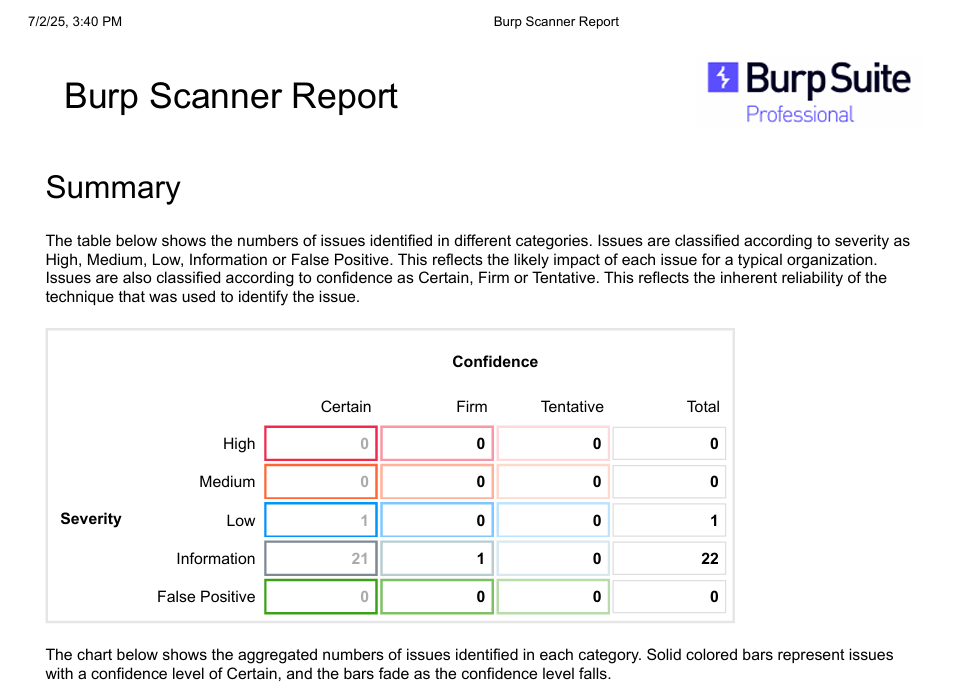
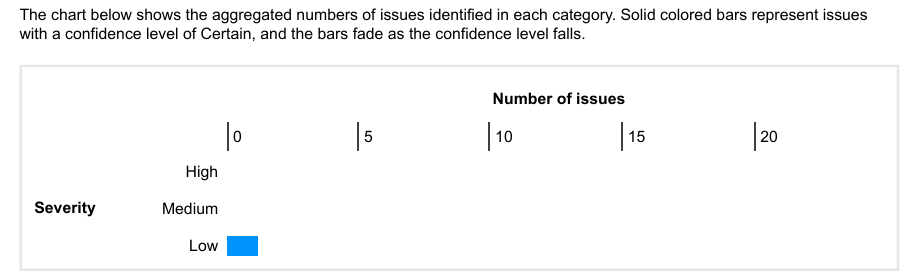
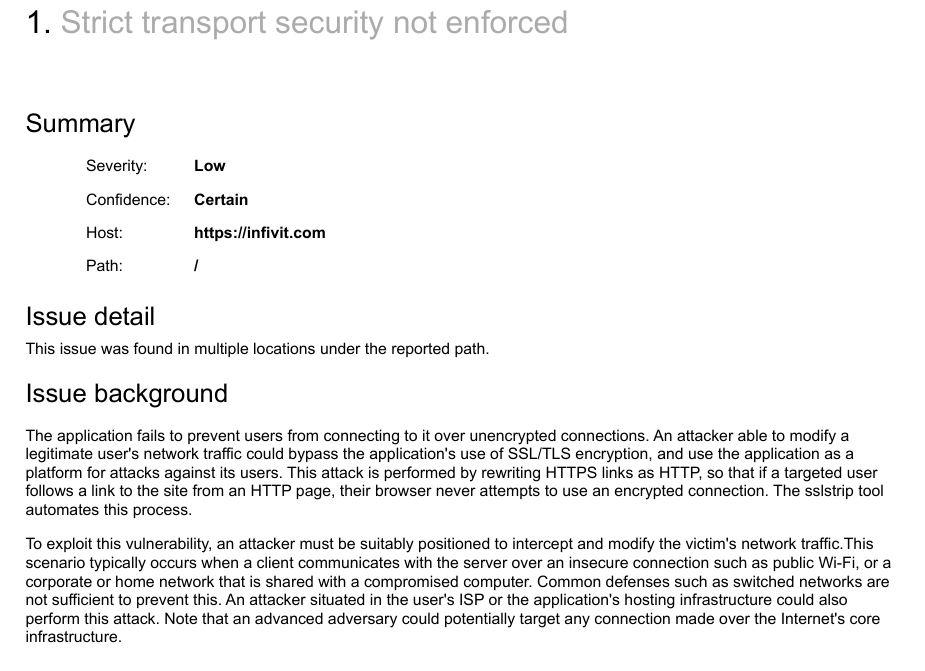
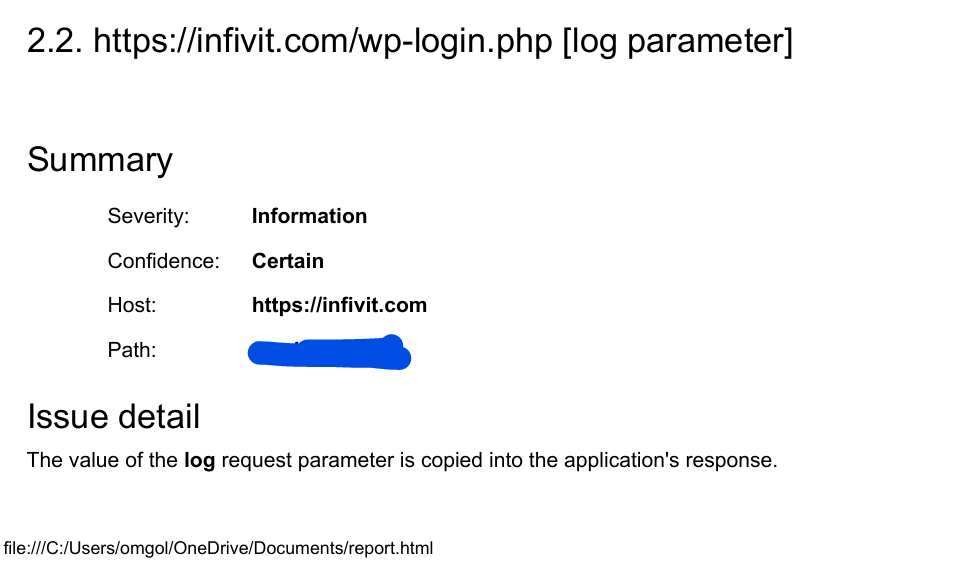
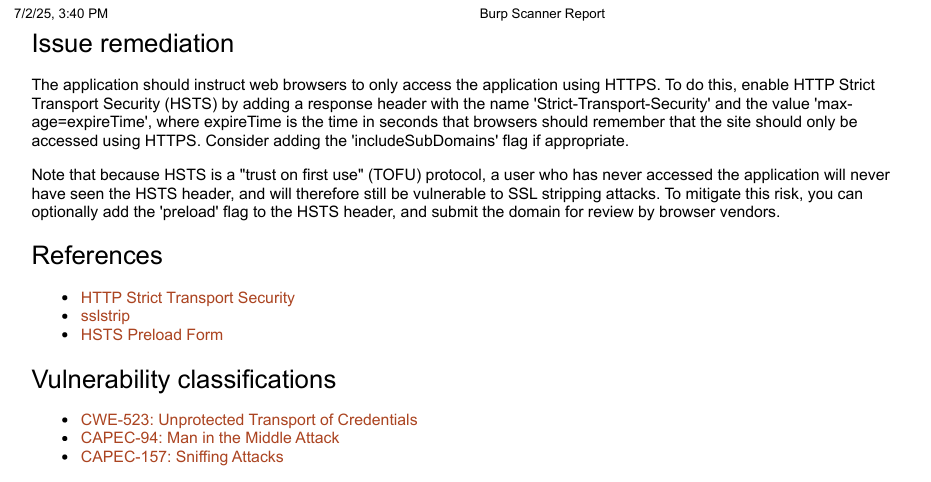
Here are the key findings from the Burp Scanner Report
-
Overall Security Posture:
-
No High or Medium severity vulnerabilities
-
22 informational findings
-
1 low-severity finding
-
-
Low-Severity Issue:
-
Strict Transport Security (HSTS) Not Enforced
Without HSTS, attackers can potentially downgrade HTTPS to HTTP on unsafe networks, enabling SSL stripping. This increases risk for users on public Wi-Fi.
-
-
Informational Issues:
-
Reflected Input in Response (three cases) These parameters reflect user input. While not harmful by themselves, they can be used for XSS if additional controls are weak.
-
Cross-Domain Referer Leakage (two cases): Query parameters could be exposed to external domains via the Referer header. If the third-party domain is not fully trusted, information leakage may occur.
-
Common Web Application Attack Vectors to look for…
OWASP CategoryDescriptionHow Attackers Exploit ItHow to Fix ItA03:2021 InjectionUntrusted data executed as commands/queriesSQLi, XSSInput checks, encoding, prepared statements, CSPA01:2021 Broken Access ControlRestrictions not enforced properlyIDOR, privilege escalationLeast privilege, session securityA02:2021 Cryptographic FailuresData not protected properlyWeak encryption, on-path attacksStrong encryption, no caching of sensitive dataA04:2021 Insecure DesignArchitectural weaknessesPredictable flowsThreat modelling, secure designA05:2021 MisconfigurationsUnsafe default settingsDefault creds, exposed filesHardening, updatesA06:2021 Outdated ComponentsOld libraries with known issuesCVE exploitationPatch management, SCAA07:2021 Auth FailuresWeak login systemsPassword attacks, missing MFAStrong password rules, MFAA08:2021 Integrity FailuresUntrusted updates or pluginsTamperingSignatures, verificationA09:2021 Log/Monitoring FailuresAttacks go unnoticedSilent breachesBetter logging, real-time alertsA10:2021 SSRFServer sends unwanted requestsAccessing internal servicesInput validation, network rules
Conclusion
Penetration testing is not just a compliance requirement—it is a crucial part of maintaining a secure and reliable digital environment. At Infivit Technologies, we use a mix of automated tools and expert manual testing to uncover threats early and strengthen the overall security posture of our applications.
A well-executed penetration test ensures your systems remain resilient, trustworthy, and ready to support your business as it grows.